Managing your finances doesn't have to follow a rigid monthly schedule. For many professionals and businesses, adopting a weekly bill pay system offers superior control over cash flow, reduces late payment stress, and provides clearer visibility into spending patterns. By breaking down your financial obligations into smaller, more manageable weekly chunks, you can align your payment schedule with your actual income flow-especially important if you're paid weekly or biweekly. This approach transforms financial management from an overwhelming monthly marathon into a series of achievable weekly sprints, making it easier to spot potential problems before they become serious issues.
Understanding the Weekly Bill Pay Method
The weekly bill pay approach divides your monthly financial obligations into four or five weekly cycles rather than handling everything at month's end. This system works by allocating specific bills to specific weeks based on due dates and cash flow availability.
Core principles include:
- Breaking monthly expenses into weekly portions
- Scheduling payments to align with income deposits
- Maintaining consistent review intervals
- Building buffer funds for irregular expenses
- Tracking spending patterns at a granular level
According to research on weekly budgeting benefits, this approach helps individuals maintain better awareness of their financial position throughout the month. Rather than wondering where your money went at month's end, you're conducting continuous financial health checks.
Why Traditional Monthly Bill Pay Falls Short
Monthly billing cycles made sense decades ago when most people received one paycheck per month. Today's employment landscape has changed dramatically. Many workers receive weekly or biweekly paychecks, creating a mismatch between income frequency and expense management.
This disconnect creates several problems. First, it encourages "batch processing" mentality where all bills get paid around the same date, creating artificial cash flow crunches. Second, it reduces visibility into daily spending habits since reviews happen only monthly. Third, it makes recovering from unexpected expenses more difficult because the feedback loop is too long.

Building Your Weekly Bill Pay Spreadsheet
Excel provides the perfect platform for managing weekly bill pay systems. The flexibility to customize formulas, automate calculations, and visualize spending patterns makes spreadsheets invaluable for financial tracking.
Essential Spreadsheet Components
Your weekly bill pay spreadsheet should include several critical elements that work together to provide comprehensive financial oversight.
| Component | Purpose | Key Features |
|---|---|---|
| Income Tracker | Records all money coming in | Date, source, amount, frequency |
| Bill Calendar | Maps due dates to weeks | Payee, amount, due date, week number |
| Payment Log | Confirms transactions | Date paid, confirmation number, method |
| Category Totals | Summarizes spending | Weekly totals, month-to-date, variance |
| Balance Projection | Forecasts available funds | Running balance, projected shortfalls |
Start by creating a master list of all recurring bills with their amounts and due dates. Creating drop-down lists in Excel for categories and payment methods will standardize your data entry and reduce errors.
Automating Your Payment Schedule
Once your foundation is built, automation becomes your next priority. Excel formulas can calculate which week each bill falls into, sum category totals automatically, and alert you to approaching due dates.
Key formulas to implement:
=WEEKNUM(due_date)to assign bills to calendar weeks=SUMIF(week_column, current_week, amount_column)for weekly totals=IF(due_date-TODAY()<=3, "DUE SOON", "")for payment alerts=previous_balance + income - expensesfor running balance calculations
The beauty of weekly bill pay lies in its predictability. When you review the same elements every seven days, patterns emerge quickly. You'll spot unusual charges faster and identify spending creep before it becomes problematic.
Categorizing Bills for Weekly Management
Not all bills fit neatly into weekly cycles. The key is categorizing your obligations strategically to match your actual cash flow and minimize cognitive load.
Fixed vs. Variable Expenses
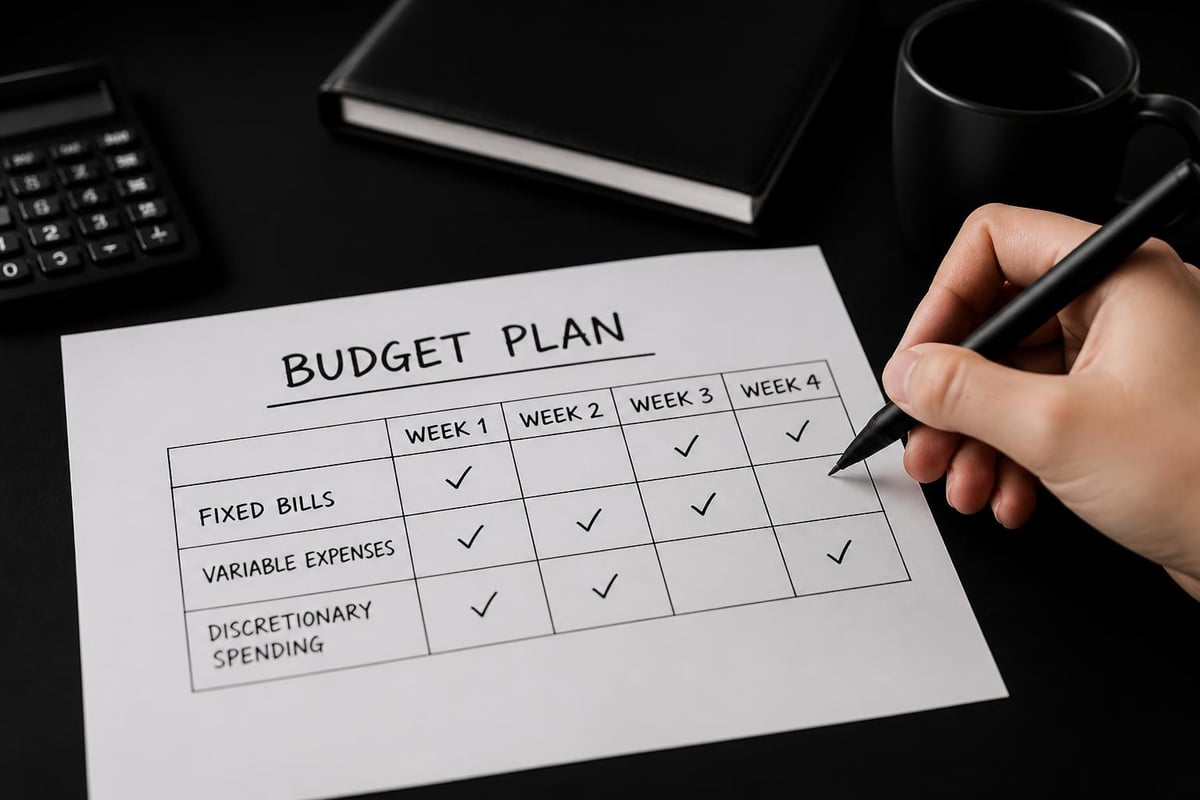
Fixed expenses remain constant month to month-rent, car payments, insurance premiums, subscription services. These should be assigned to specific weeks based on due dates. If your mortgage is due on the first, schedule it for Week One of your monthly cycle.
Variable expenses fluctuate-groceries, utilities, fuel, entertainment. For these, establish weekly allowances based on historical spending patterns. Review the past three months to calculate average weekly amounts, then add a 10-15% buffer for unexpected variations.
Strategic Payment Timing
Staggering bill payments throughout the month prevents the cash flow crunch that comes from clustering all payments around one or two dates. Look for opportunities to shift due dates by contacting service providers.
Most utility companies, credit card issuers, and lenders will accommodate requested due date changes. Spreading payment obligations across all four weeks ensures you're never depleting your entire account balance at once.
Implementing Weekly Spending Reviews
The weekly bill pay system only works if you commit to regular review sessions. These brief checkpoints-typically 15-20 minutes-keep your financial management current and accurate.
Your Weekly Review Checklist
Schedule your review for the same day and time each week. Consistency builds habit, and habits create results. Many people choose Friday afternoons or Sunday evenings when they're planning for the week ahead.
During each session:
- Verify all scheduled payments cleared correctly
- Review transaction history for unauthorized charges
- Update your spreadsheet with actual spending
- Calculate remaining weekly budget in variable categories
- Preview next week's scheduled payments
- Adjust projections based on any changes
Conducting weekly spending reviews helps maintain budget discipline and catch errors while they're still easy to correct. When you discover a billing error on Wednesday rather than six weeks later, resolution becomes significantly simpler.
Tracking Performance Metrics
Your spreadsheet should calculate key performance indicators that signal financial health. Simple metrics provide powerful insights when tracked consistently.
| Metric | Calculation | Target |
|---|---|---|
| Weekly Savings Rate | (Income – Expenses) / Income | 15-20% |
| Variable Spending % | Variable Costs / Total Income | <30% |
| Week-over-Week Change | Current Week – Previous Week | Negative trend |
| Budget Adherence | Actual / Planned Spending | 95-105% |
Building Excel dashboards that visualize these metrics transforms raw numbers into actionable intelligence. Charts showing weekly spending trends or category breakdowns make patterns immediately obvious.
Optimizing Credit Card Management
Credit card bills present unique opportunities within a weekly bill pay framework. Unlike fixed bills with set due dates, you control when and how much you pay on revolving credit.
The Weekly Payment Advantage
Paying credit card bills weekly offers several benefits beyond simply staying current. Frequent payments reduce your average daily balance, which can improve credit utilization ratios-a key factor in credit scores.
More importantly, weekly payments provide psychological benefits. When you pay off purchases within days rather than waiting until month's end, you maintain stronger awareness of your actual spending. This immediate feedback loop discourages impulse purchases and promotes more thoughtful financial decisions.
Creating a Credit Card Payment Schedule
Dedicate one day each week to reviewing credit card activity and making payments. Even if you're not paying the full balance weekly, consistent partial payments demonstrate strong financial management and keep your utilization low.
For multiple cards, stagger review days to distribute the workload. Monday for Card A, Wednesday for Card B, Friday for Card C. This prevents review fatigue while ensuring nothing falls through the cracks.
Adapting Weekly Bill Pay to Your Pay Schedule
The effectiveness of weekly bill pay depends partly on aligning it with your income frequency. Different pay schedules require different tactical approaches.
Weekly Paycheck Strategy
If you're paid weekly, you have the most natural fit for weekly bill pay. Each paycheck funds that week's obligations with minimal carryover needed.
Strategic allocation approach:
- Week One: Rent/mortgage (typically largest expense) plus utilities
- Week Two: Insurance premiums and subscription services
- Week Three: Debt payments (student loans, car payment)
- Week Four: Variable expenses catchup and savings contributions
Budgeting on a weekly paycheck requires discipline to avoid spending money designated for future weeks. Using separate savings accounts for bills versus discretionary spending creates useful guardrails.
Biweekly Income Adaptation
Biweekly pay cycles create a unique challenge-most months have four weeks, but you receive only two paychecks. This requires splitting each paycheck to fund two weeks of expenses.
The solution involves front-loading fixed expenses from the first paycheck while reserving the second for variable costs and savings. Alternatively, creating a biweekly budget that treats each paycheck as covering a two-week period can simplify tracking while maintaining weekly reviews.
Those two "extra" paychecks per year-when five weeks fall between pay periods-should flow directly to emergency funds or debt acceleration rather than increasing lifestyle expenses.
Handling Irregular and Annual Expenses
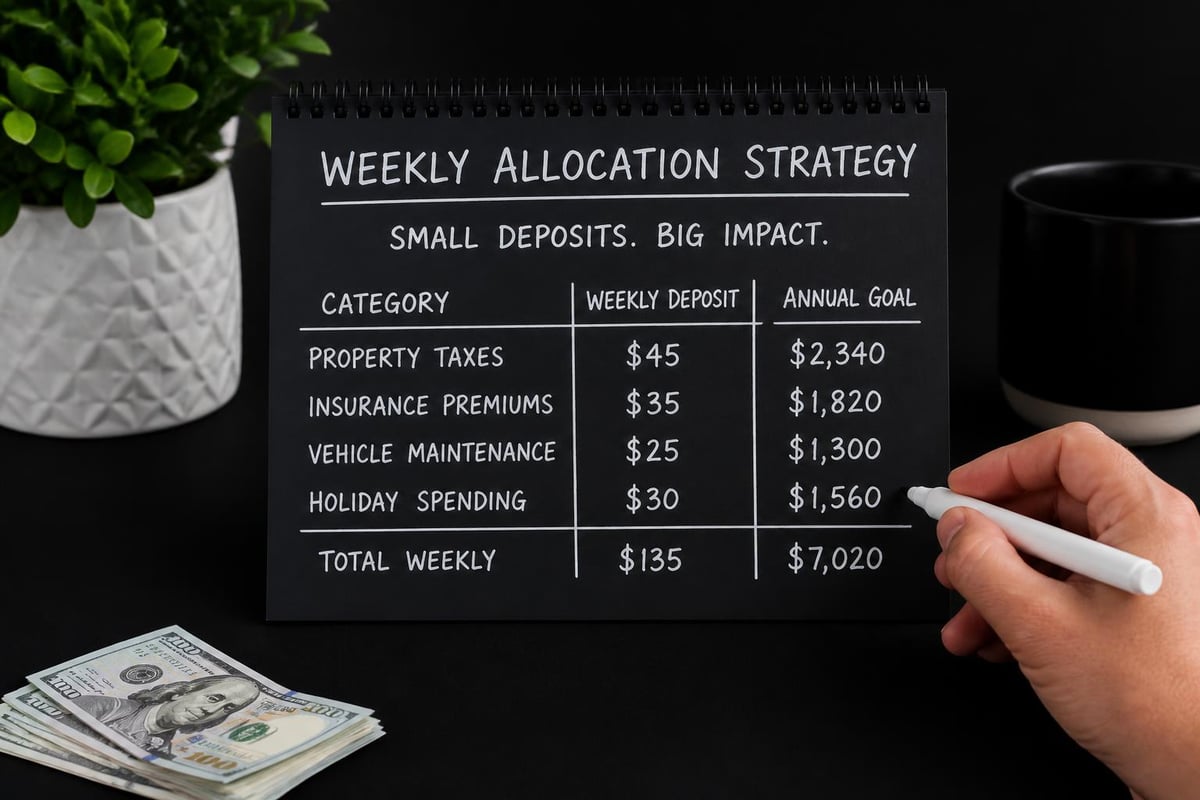
Weekly bill pay excels at managing recurring obligations, but irregular expenses require different planning mechanisms. Property taxes, annual insurance premiums, holiday spending, and car maintenance don't fit neatly into weekly cycles.
The Sinking Fund Approach
Create virtual "sinking funds" within your spreadsheet for each irregular expense category. Calculate the annual cost, divide by 52 weeks, and allocate that amount weekly.
For example, if property taxes total $3,120 annually, set aside $60 per week. When the bill arrives, you've accumulated the necessary funds without disrupting your regular cash flow. This approach transforms unpredictable large expenses into predictable small ones.
Track these funds in a dedicated section of your weekly bill pay spreadsheet. Even if the money physically stays in your checking account, accounting for it separately prevents you from treating it as available for regular spending.
Troubleshooting Common Weekly Bill Pay Challenges
Even well-designed systems encounter obstacles. Understanding common challenges and their solutions prevents temporary setbacks from derailing your entire financial management approach.
Cash Flow Timing Mismatches
The most frequent problem occurs when bill due dates cluster before paychecks arrive. This creates temporary shortfalls even when monthly income exceeds monthly expenses.
Solutions include:
- Building a one-week buffer in your checking account
- Requesting due date changes from creditors
- Using a 0% interest credit card for timing arbitrage (pay immediately upon paycheck deposit)
- Establishing a small line of credit for true emergencies
Data Entry Fatigue
Weekly reviews mean weekly data entry. After initial enthusiasm fades, maintaining your spreadsheet can feel burdensome.
Combat this by streamlining your process. Link bank accounts to automatically download transactions, use formulas to categorize spending based on payee names, and implement data validation rules that prevent entry errors. The less manual typing required, the more sustainable your system becomes.
Shared Household Finances
When multiple people contribute to household expenses, coordinating weekly bill pay becomes more complex. Different pay schedules, varying income levels, and individual spending habits require clear communication and agreed-upon systems.
Create a shared spreadsheet with clearly defined responsibility zones. One person might handle housing costs while another manages utilities and groceries. Weekly household financial meetings-brief, focused, agenda-driven-keep everyone aligned and accountable.
Advanced Spreadsheet Techniques for Bill Management
Once your basic weekly bill pay system operates smoothly, advanced Excel features can enhance functionality and provide deeper insights.
Conditional Formatting for Visual Cues
Conditional formatting transforms your spreadsheet from a static ledger into a dynamic dashboard. Color-code cells based on payment status-green for paid, yellow for due within three days, red for overdue.
Highlight weeks where projected expenses exceed projected income in orange, triggering preemptive action rather than reactive scrambling. These visual signals make spreadsheet reviews faster and more effective.
Pivot Tables for Spending Analysis
Creating pivot tables from your weekly payment data reveals spending patterns that aren't obvious from line-by-line review. Analyze which categories consume the largest percentage of income, how spending varies by week or month, and where reduction opportunities exist.
Quarter-over-quarter comparisons identify whether lifestyle inflation is occurring. Year-over-year analysis shows the impact of rate increases on utilities, insurance, and other services, informing negotiation strategies with providers.
Formula Auditing and Error Prevention
Financial spreadsheets demand accuracy. A single formula error can cascade through your entire system, producing incorrect balances and faulty projections.
Regular auditing of complex spreadsheets prevents catastrophic errors. Use Excel's trace precedents and trace dependents features to visualize formula relationships. Implement reasonableness checks that flag impossible values-like negative income or expenses exceeding ten times normal amounts.
Scaling Weekly Bill Pay for Business Use
While weekly bill pay benefits individuals, small businesses and freelancers gain even greater advantages from this approach. Business cash flow is often more variable than personal income, making weekly monitoring essential.
Accounts Payable Management
Businesses juggling multiple vendor relationships, net-30 payment terms, and varying invoice amounts need robust tracking systems. Weekly reviews ensure invoices get paid promptly to maintain vendor relationships while preserving cash for as long as terms allow.
Create separate spreadsheet tabs for different vendor categories. Consolidate them in a master summary that shows total weekly outflows across all categories. This structure provides both detailed transaction history and high-level cash flow projection.
Client Payment Tracking
For freelancers and consultants, weekly bill pay spreadsheets should include an accounts receivable component. Track which clients owe money, when payment is expected, and how that incoming cash will fund upcoming obligations.
When a client payment arrives late, your spreadsheet immediately shows which bills might be impacted, allowing proactive communication with creditors rather than missing due dates.
Building Resilience Through Emergency Planning
Even the most carefully planned weekly bill pay system encounters unexpected disruptions. Job loss, medical emergencies, major repairs, and economic downturns require resilient financial structures.
Emergency Fund Integration
Your weekly bill pay spreadsheet should include a dedicated emergency fund tracker showing current balance, weekly contribution amount, and progress toward your target (typically three to six months of essential expenses).
Emergency fund growth strategy:
- Calculate total essential monthly expenses (housing, utilities, food, transportation, insurance)
- Multiply by your target months of coverage (3-6 months)
- Divide the gap between current savings and target by 52 weeks
- Add that weekly contribution to your bill pay schedule as a non-negotiable "bill to yourself"
When emergencies arise, having accurate weekly expense tracking makes it simple to calculate how long your emergency fund will last and which expenses can be temporarily reduced or eliminated.
Scenario Planning
Use your historical weekly data to model various scenarios. What happens if income drops 25%? Which expenses could be cut immediately versus which require notice periods? How would you prioritize limited funds across competing obligations?
Creating these contingency plans during calm times-when emotions don't cloud judgment-produces better decisions than making them during actual crises. Your spreadsheet becomes not just a tracking tool but a strategic planning instrument.
Measuring Long-Term Financial Progress
Weekly bill pay provides granular data that, when aggregated over time, reveals your overall financial trajectory with remarkable clarity.
Calculating True Savings Rate
Many people believe they save money when they're actually just building credit card debt more slowly. True savings rate calculations require comparing total income against total spending over complete cycles.
Your weekly tracking enables precise calculations: total deposits minus total debits over 13 weeks (one quarter) divided by total deposits. This percentage shows exactly what portion of your income you're converting to wealth rather than just spending.
Net Worth Tracking
While weekly bill pay focuses on cash flow, monthly net worth calculations provide the complementary view of wealth accumulation. On the first of each month, record all asset values (checking, savings, investments, retirement accounts, property equity) and all liability balances (credit cards, loans, mortgage).
Plotting net worth over time creates a powerful visualization of financial progress that transcends the day-to-day expense management. Your weekly diligence translates into growing wealth over months and years.
Mastering weekly bill pay transforms financial management from a monthly chore into a sustainable, empowering routine that provides continuous visibility into your cash flow and spending patterns. Whether you're managing personal finances or running a small business, the combination of structured scheduling, regular reviews, and data-driven decision-making creates lasting financial stability. If you're ready to build a bulletproof Excel system for tracking your weekly bill pay-or need help fixing formulas, automating calculations, or designing dashboards that make your financial data crystal clear-The Analytics Doctor is here to help. From custom spreadsheet solutions to personalized training that makes you an Excel power user, you'll get the expert support you need to make your financial tracking work flawlessly.