Managing park operations, recreational facilities, or venue-based businesses requires exceptional organizational skills and reliable data tracking systems. Whether you're overseeing a recreational area, planning a development project, or managing day-to-day operations, excel templates deer park solutions offer powerful tools to transform raw data into actionable insights. These templates help streamline everything from visitor management and revenue forecasting to resource allocation and compliance reporting, making them indispensable for modern park administrators and facility managers.
Understanding Excel Templates for Park Management
Excel templates designed for park-related operations serve as pre-formatted spreadsheets that eliminate the need to build tracking systems from scratch. These tools provide structured frameworks for capturing critical data points while maintaining consistency across reporting periods.
Key benefits of using specialized templates include:
- Reduced setup time for new tracking systems
- Standardized data collection across departments
- Built-in formulas that minimize calculation errors
- Customizable fields to match specific operational needs
- Professional formatting that's ready for stakeholder presentations
The right excel templates deer park solution adapts to various facility types, from small community parks to large-scale recreational complexes. For organizations seeking Excel training to maximize template effectiveness, expert guidance ensures teams can fully leverage these tools.
Financial Planning and Forecasting Templates
Financial management represents one of the most critical applications for excel templates deer park professionals utilize. Sophisticated financial models allow park managers to project revenues, track expenses, and plan capital improvements with confidence.
Organizations developing new facilities benefit significantly from specialized financial templates. The animal park zoo development financial model provides a dynamic 10-year forecast that assists with operational projections and investment planning. Similarly, the theme park and hotel financial model covers construction phases, operational budgets, and long-term valuation scenarios.

| Template Type | Primary Use Case | Time Horizon | Complexity Level |
|---|---|---|---|
| Revenue Tracking | Daily operations monitoring | Monthly/Quarterly | Beginner |
| Budget Planning | Annual financial planning | 12 months | Intermediate |
| Development Models | New facility planning | 5-10 years | Advanced |
| Cash Flow Analysis | Liquidity management | Rolling 12 months | Intermediate |
Operational Management and Resource Tracking
Beyond financial planning, excel templates deer park managers implement cover operational workflows, staff scheduling, maintenance tracking, and visitor services. These operational templates create accountability while providing visibility into daily activities.
Visitor and Attendance Management
Tracking visitor patterns helps optimize staffing levels, identify peak periods, and improve resource allocation. A well-designed attendance template captures entry data, categorizes visitor types, and generates trend reports automatically.
Essential tracking elements include:
- Date and time of entry
- Visitor category (individual, family, group, member)
- Revenue per visit
- Duration of stay
- Special services utilized
Professional Excel consultancy services can help design custom visitor tracking systems that integrate with existing property management software. This integration ensures data flows seamlessly between systems without manual re-entry.
Maintenance and Asset Management
Parks require ongoing maintenance across numerous assets, from playground equipment to landscaping features. Excel templates that track maintenance schedules prevent oversight and extend asset lifecycles.
A comprehensive maintenance template should include:
- Asset inventory with identification numbers
- Scheduled maintenance intervals
- Completed service records
- Cost tracking by asset category
- Vendor performance metrics
- Priority flagging for critical repairs
When teams struggle with complex formulas or broken spreadsheets, knowing how to audit and debug complex Excel spreadsheets becomes essential for maintaining data integrity.
Specialized Templates for Different Park Types
Different facility types require tailored approaches to data management. Excel templates deer park professionals select should align with specific operational models and reporting requirements.
Recreational Vehicle and Mobile Home Parks
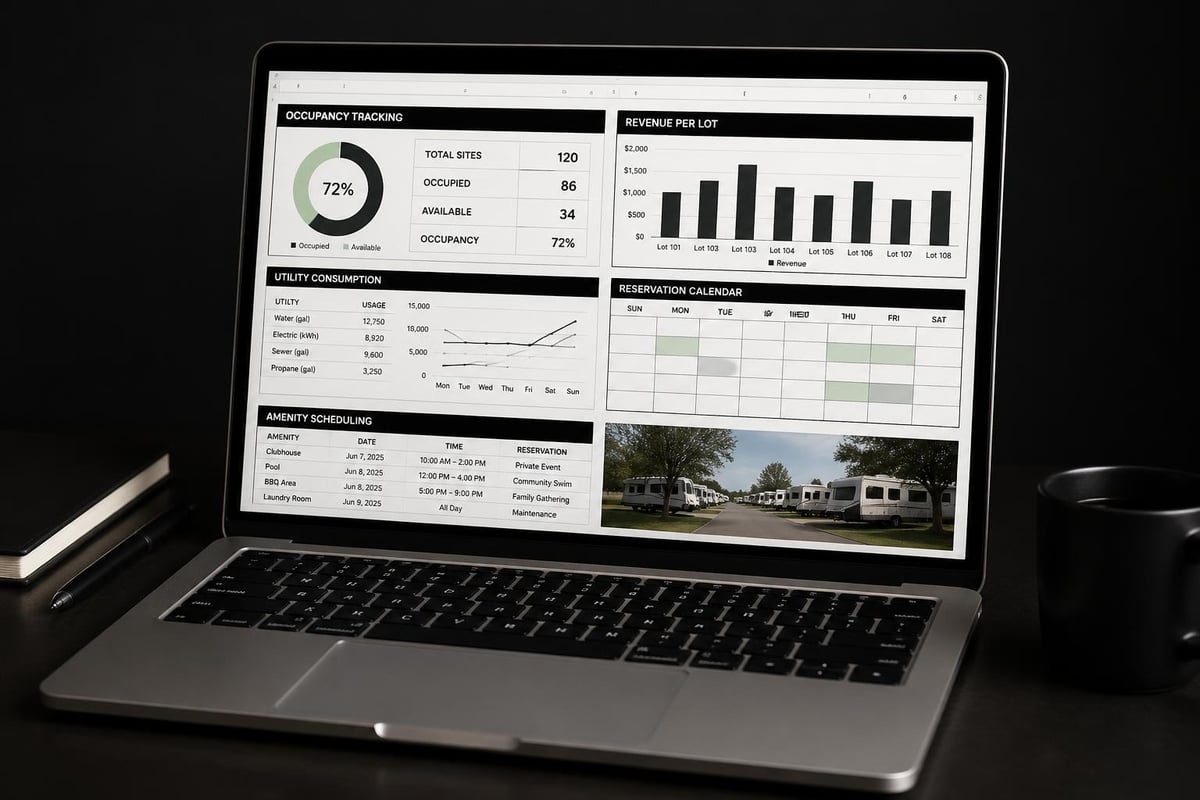
RV parks and mobile home communities have unique financial characteristics that standard templates may not address. The RV park development financial model offers a 10-year planning framework designed specifically for these properties.
These specialized templates account for:
- Lot-based revenue models
- Utility cost allocation
- Seasonal occupancy variations
- Long-term vs. transient resident tracking
- Amenity usage patterns
The RV park developer financial projection template creates investor-ready documents including income statements, cash flow projections, and balance sheets. For acquisition scenarios, the real estate RV park acquisition model helps evaluate investment feasibility with sophisticated analysis tools.
Wildlife and Nature Reserves
Parks focused on wildlife management or conservation require specialized tracking beyond typical recreational facilities. The deer management plan template from Cornell University outlines essential components for comprehensive management strategies.
Conservation-focused excel templates deer park managers employ track:
- Wildlife population surveys
- Habitat restoration projects
- Volunteer coordination
- Educational program participation
- Grant funding and compliance reporting
Understanding data validation in Excel ensures wildlife survey data remains accurate and consistent across multiple data collectors.
Building Custom Templates for Unique Requirements
While pre-built templates offer excellent starting points, many organizations benefit from customized solutions that address specific workflows. Creating custom excel templates deer park operations demand requires careful planning and design.
Template Design Best Practices
Start with clear objectives. Define exactly what data you need to capture, how often you'll update it, and who will use the reports generated. This clarity prevents scope creep and keeps templates focused.
Implement robust data validation. Use dropdown lists, date restrictions, and numeric limits to prevent data entry errors. Learning how to create drop-downs in Excel enhances template usability significantly.
Design for scalability. Templates should accommodate growth without requiring complete rebuilds. Use Excel tables, named ranges, and dynamic formulas that expand automatically.
| Design Element | Purpose | Implementation Method |
|---|---|---|
| Data Validation | Error prevention | Dropdown lists, custom rules |
| Conditional Formatting | Visual alerts | Rule-based formatting |
| Named Ranges | Formula clarity | Define ranges with descriptive names |
| Protected Cells | Prevent overwrites | Lock formula cells, unlock input areas |
| Documentation | User guidance | Comments, instruction sheets |
Dashboard Creation for Executive Reporting
Senior management needs high-level insights without wading through detailed data. Excel dashboards consolidate key performance indicators into visual, easy-to-interpret formats.
A comprehensive guide on how to create dashboards in Excel walks through the process of building interactive reporting tools. Effective dashboards for park management typically include:
- Occupancy trends showing seasonal patterns
- Revenue metrics comparing actual to budget
- Maintenance status highlighting overdue items
- Staff productivity measuring key performance indicators
- Visitor satisfaction tracking feedback scores
The financial planning dashboard template provides robust tools for net worth tracking, goal planning, and cash flow analysis that adapt well to park financial management.
Data Integration and Automation Strategies
Modern excel templates deer park operations utilize should connect with other systems to minimize manual data entry and reduce errors. Integration strategies range from simple copy-paste workflows to sophisticated automation using VBA or Power Query.
Connecting Excel with External Data Sources
Excel's Power Query feature enables direct connections to databases, web services, and other spreadsheets. This capability transforms static templates into dynamic reporting tools that refresh with current data.
Common integration scenarios include:
- Point-of-sale systems feeding revenue data
- Reservation platforms providing occupancy information
- Weather services supplying environmental data
- Government databases offering demographic information
For organizations ready to implement advanced automation, Excel VBA programming services provide custom solutions that handle complex workflows and multi-system integrations.

Reducing File Size and Improving Performance
As templates accumulate data over time, file size can balloon, leading to slow performance and potential corruption. Understanding how to reduce Excel file size becomes critical for maintaining usable templates.
Effective size reduction techniques:
- Archive historical data to separate workbooks
- Remove unused formatting and styles
- Compress images and embedded objects
- Eliminate hidden sheets and ranges
- Convert static data to values
Template Maintenance and Version Control
Excel templates deer park teams depend on require ongoing maintenance to remain accurate and useful. Establishing clear protocols for updates, backups, and version control prevents confusion and data loss.
Implementing Change Management Protocols
When multiple team members use the same templates, coordinating changes becomes essential. Without proper protocols, conflicting versions create chaos and undermine data reliability.
Recommended version control practices:
- Designate a template owner responsible for updates
- Maintain a change log documenting all modifications
- Use clear naming conventions with version numbers
- Store master copies in a centralized location
- Restrict editing permissions to authorized personnel
Organizations can learn how to protect an Excel workbook to prevent unauthorized changes while allowing appropriate access for data entry.
Regular Audits and Quality Checks
Periodic template audits identify formula errors, broken links, and outdated assumptions before they impact decision-making. Schedule quarterly reviews that verify:
- Formula accuracy across all calculations
- Data validation rules remain appropriate
- Formatting enhances rather than obscures information
- Documentation stays current with actual workflows
- User feedback gets incorporated into updates
The Excel data validation rules and checks guide provides a comprehensive checklist for bulletproofing spreadsheet models.
Compliance and Reporting Requirements
Parks operating on public land or receiving government funding face specific reporting obligations. Excel templates deer park administrators design must capture required data elements and generate compliant reports efficiently.
Meeting Regulatory Standards
The National Park Service inventory guidance provides templates and standards for data collection and management in park environments. These resources ensure consistency across reporting periods and facilitate audits.
Critical compliance considerations include:
- Standard data formats matching regulatory requirements
- Timestamp tracking for data modification
- User access logs for sensitive information
- Retention policies aligned with legal requirements
- Backup procedures ensuring data preservation
Creating Audit-Ready Documentation
Well-documented templates survive audits more successfully than those lacking clear explanations. Include comprehensive documentation that covers:
- Purpose and scope of the template
- Data sources and collection methods
- Formula explanations for key calculations
- Assumptions underlying projections
- Limitations and known issues
When spreadsheets contain errors that need investigation, knowing how to compare two spreadsheets helps identify discrepancies quickly and systematically.
Training Teams for Template Success
Even the most sophisticated excel templates deer park organizations implement fail without proper user training. Investment in skill development ensures teams extract maximum value from these tools.
Developing Internal Excel Expertise
Building Excel competency across your organization reduces dependence on external consultants while empowering staff to solve problems independently. Structured training programs should cover:
- Basic navigation and data entry techniques
- Understanding existing formulas without breaking them
- Creating simple reports from template data
- Recognizing and reporting errors
- Following established protocols for template use
Corporate Excel training programs deliver practical, hands-on instruction tailored to specific organizational needs and existing skill levels.
Creating User Guides and Reference Materials
Comprehensive documentation supports training efforts and provides ongoing reference for occasional users. Effective user guides include:
- Step-by-step instructions with screenshots
- Common troubleshooting scenarios and solutions
- Frequently asked questions
- Contact information for technical support
- Tips for maximizing template efficiency
Advanced Features for Sophisticated Analysis
Excel templates deer park managers use can incorporate advanced features that transform basic tracking into sophisticated analytical tools. Power users benefit from understanding these capabilities.
Scenario Planning and Sensitivity Analysis
Financial templates become more valuable when they model multiple scenarios. What-if analysis helps evaluate decisions before committing resources.
Create scenario models that test:
- Impact of admission price changes on revenue
- Effects of varying occupancy rates
- Sensitivity to labor cost fluctuations
- Weather impact on seasonal operations
- Capital improvement return on investment
Implementing Data Modeling with Power Pivot
For organizations managing large datasets across multiple facilities, Power Pivot extends Excel's analytical capabilities dramatically. The comprehensive guide to Power Pivot and data modeling in Excel provides a step-by-step checklist for building error-proof, scalable models.
Power Pivot advantages include:
- Handling millions of rows efficiently
- Creating relationships between multiple data tables
- Building sophisticated calculated measures
- Generating pivot tables with enhanced functionality
- Improving performance over traditional methods
Excel templates deer park operations depend on provide structured frameworks that transform data chaos into actionable insights. From financial forecasting and operational tracking to compliance reporting and strategic planning, well-designed templates save time while improving accuracy. Whether you're implementing pre-built solutions or developing custom templates, the key lies in matching tools to your specific needs while building team capacity to use them effectively. If your spreadsheets aren't delivering the insights you need, or if formulas are breaking and data doesn't make sense, The Analytics Doctor offers expert help to diagnose problems, build better templates, and train your team to work smarter with Excel.