The demand for professionals who can bridge marketing strategy and data analysis has never been higher. A marketing analytics consultant excel expert combines strategic business insight with technical spreadsheet proficiency to transform raw marketing data into actionable intelligence. Whether you're tracking campaign performance, analyzing customer behavior, or forecasting revenue trends, Excel remains the foundation for most marketing analytics work. Understanding how consultants leverage Excel's powerful capabilities can help you develop the skills needed to compete in today's data-driven marketing landscape.
The Essential Role of Excel in Marketing Analytics Consulting
Marketing analytics has evolved significantly over the past decade, with comprehensive methods and practices shaping how businesses approach data-driven decision-making. Despite the proliferation of specialized analytics platforms, Excel continues to serve as the backbone for marketing analytics consultants across industries.
Why Excel Dominates Marketing Analytics
Excel's versatility makes it indispensable for marketing analytics consultant excel professionals. The platform offers immediate accessibility without requiring expensive software licenses or extensive IT infrastructure. Teams can collaborate easily, and virtually every stakeholder understands how to open and review an Excel file.
Key advantages that keep Excel central to marketing analytics:
- Universal compatibility across organizations and systems
- Flexibility to customize analyses without coding constraints
- Rapid prototyping of analytical models and dashboards
- Integration capabilities with CRM, advertising platforms, and databases
- Cost-effectiveness compared to enterprise analytics solutions
The transformation of Excel into an integrated analytics environment has expanded its capabilities far beyond simple spreadsheets. Modern Excel supports advanced statistical functions, data modeling through Power Pivot, and interactive visualizations that rival dedicated business intelligence tools.

Core Competencies for Marketing Analytics Consultant Excel Experts
Success as a marketing analytics consultant excel specialist requires mastering both marketing concepts and technical Excel skills. The intersection of these domains creates unique value for organizations seeking to optimize their marketing investments.
Data Collection and Integration Techniques
Marketing data originates from dozens of sources, each with different formats and update frequencies. A skilled consultant knows how to consolidate this fragmented information into coherent analytical frameworks.
| Data Source | Typical Metrics | Integration Method |
|---|---|---|
| Google Analytics | Sessions, conversions, bounce rate | API export to CSV, Power Query |
| Social Media Platforms | Engagement, reach, follower growth | Platform exports, third-party tools |
| Email Marketing | Open rate, click-through, unsubscribes | Direct CSV downloads |
| CRM Systems | Lead volume, conversion rate, pipeline value | Database connections, ODBC |
| Advertising Platforms | Impressions, CPC, ROAS, conversions | Automated reporting, API pulls |
Power Query has revolutionized how marketing analytics consultant excel professionals handle data integration. This tool automates the extraction, transformation, and loading process, reducing manual data entry errors and saving countless hours each month.
Building Analytical Models for Marketing Performance
Once data is consolidated, the real analytical work begins. Marketing consultants develop models that answer critical business questions about channel effectiveness, customer lifetime value, and campaign ROI.
Essential formulas and functions for marketing analytics:
- SUMIFS and AVERAGEIFS for segmented performance analysis
- INDEX/MATCH for dynamic data lookups across campaigns
- XLOOKUP for simplified reference matching in large datasets
- Array formulas for complex multi-variable calculations
- Statistical functions like STDEV, CORREL, and FORECAST for trend analysis
Professionals who excel at creating dashboards in Excel understand that visualization drives understanding. Charts, conditional formatting, and slicers transform raw numbers into strategic insights that non-technical stakeholders can immediately grasp.
Advanced Dashboard Development for Marketing Metrics
A marketing analytics consultant excel specialist distinguishes themselves through dashboard creation that balances sophistication with usability. Executives need to see performance at a glance, while marketing managers require drill-down capabilities for tactical adjustments.
Dashboard Design Principles
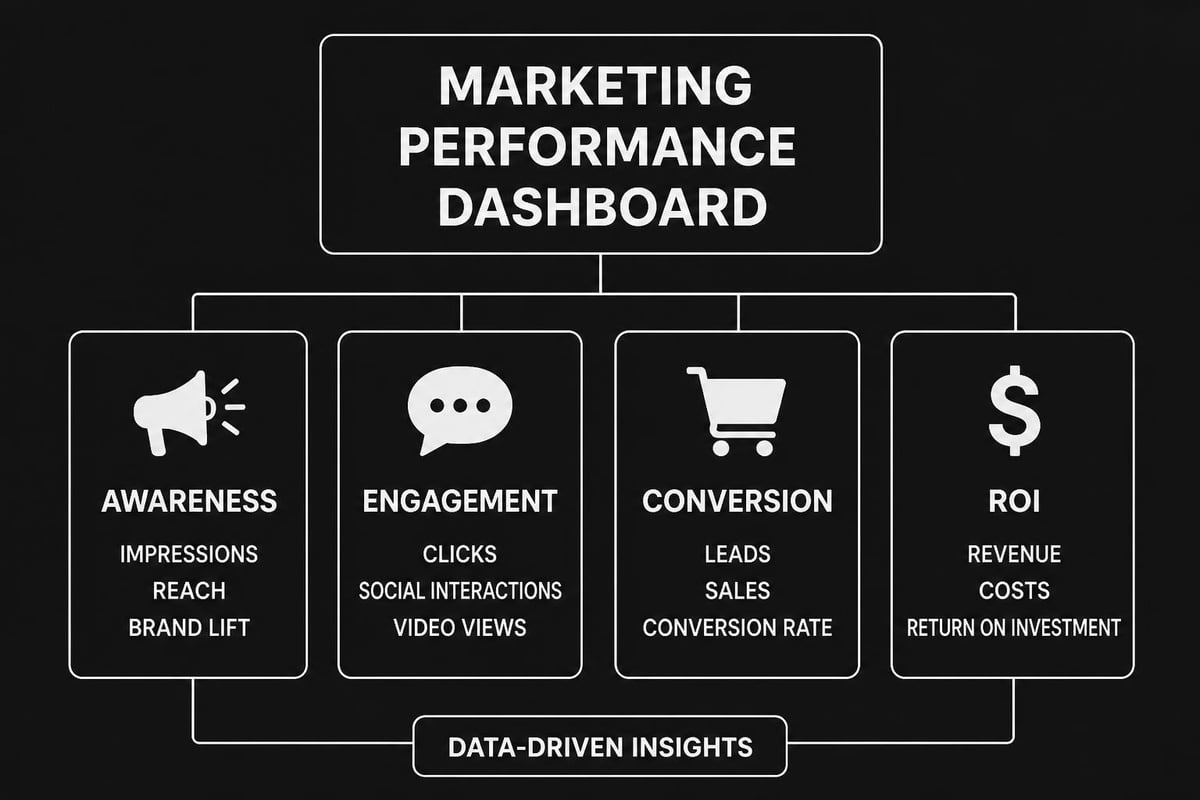
Effective marketing dashboards follow specific design principles that prioritize clarity and actionability. The consultant must decide which metrics deserve prominent placement and how to organize information hierarchically.
Start with the marketing funnel as your structural framework. Position top-of-funnel metrics like awareness and reach at the dashboard's top, followed by consideration metrics, and finally conversion and retention data. This natural flow mirrors how marketing teams think about campaign performance.
Color coding strategy for instant comprehension:
- Green for metrics exceeding targets
- Yellow for metrics within 10% of goals
- Red for underperforming indicators requiring immediate attention
- Blue for informational data without target associations
Conditional formatting automates this visual system, ensuring dashboards update automatically as new data arrives. Combined with named ranges and dynamic formulas, your dashboard becomes a living document that requires minimal manual intervention.
Interactive Elements and User Controls
Static dashboards limit analytical flexibility. A sophisticated marketing analytics consultant excel approach incorporates interactive elements that empower users to explore data from multiple perspectives.
Slicers connected to pivot tables enable filtering by date range, campaign type, geographic region, or customer segment. Drop-down menus created with data validation let users switch between different metric views without creating separate dashboard versions. This interactivity transforms a simple report into an analytical tool.
Form controls linked to formulas add another layer of functionality. A spinner control might adjust time periods for trend analysis, while option buttons switch between revenue and unit-based performance views. These elements create professional-grade interfaces without requiring VBA programming knowledge.
Campaign Attribution and ROI Calculation Methods
Understanding which marketing channels drive results remains one of the most challenging aspects of marketing analytics. Consultants must develop attribution models that fairly credit multiple touchpoints along the customer journey.
Multi-Touch Attribution in Excel
Single-touch attribution models oversimplify the complex reality of modern customer journeys. Customers typically interact with brands across multiple channels before converting, requiring more nuanced analytical approaches.
| Attribution Model | Description | Excel Implementation Difficulty |
|---|---|---|
| First-Touch | Credits initial interaction | Simple (single lookup) |
| Last-Touch | Credits final interaction before conversion | Simple (single lookup) |
| Linear | Distributes credit equally across all touchpoints | Moderate (array formulas) |
| Time-Decay | Weights recent interactions more heavily | Advanced (custom formulas) |
| Position-Based | Credits first/last at 40% each, middle at 20% | Advanced (conditional logic) |
Implementing time-decay attribution requires calculating the time elapsed between each touchpoint and the conversion, then applying exponential decay formulas. While complex, these models provide more accurate insights into channel effectiveness than simple first or last-touch approaches.
Calculating True Marketing ROI
Many organizations confuse revenue attribution with ROI calculation. A marketing analytics consultant excel expert helps stakeholders understand the critical difference between these metrics and implements proper ROI tracking.
The fundamental ROI formula divides net profit by total investment, but marketing applications require careful definition of both variables. Net profit must account for product costs, fulfillment expenses, and customer service overhead, not just gross revenue. Investment includes direct channel costs plus allocated personnel time and creative development expenses.
Connecting these calculations to campaign-level data requires sophisticated Excel modeling. Advanced Excel projects often involve building custom templates that automatically pull cost data from accounting systems and match it with revenue attribution from marketing platforms.
Forecasting and Predictive Analytics Techniques
Forward-looking analysis separates tactical reporting from strategic consulting. Marketing analytics consultant excel professionals leverage Excel's statistical capabilities to forecast future performance and identify emerging trends before they become obvious.
Time Series Analysis for Marketing Trends
Marketing metrics exhibit seasonal patterns, growth trends, and cyclical variations that sophisticated analysis can quantify and predict. Excel's forecasting functions have improved dramatically in recent years, offering accessible predictive capabilities.
The FORECAST.ETS function family handles exponential smoothing automatically, accounting for seasonality and trend components without requiring manual parameter adjustment. For monthly website traffic forecasting, this function analyzes historical patterns and projects future values with associated confidence intervals.
Steps for building marketing forecasts:
- Organize historical data in chronological order with consistent time intervals
- Identify and handle outliers caused by one-time events or data errors
- Apply FORECAST.ETS.SEASONALITY to detect recurring patterns
- Generate forecasts using FORECAST.ETS with appropriate confidence levels
- Validate predictions against holdout data to assess accuracy
Moving averages smooth short-term fluctuations to reveal underlying trends. A 12-month moving average for revenue removes monthly volatility, making it easier to assess whether marketing initiatives are driving sustainable growth or merely causing temporary spikes.
Regression Analysis for Driver Identification
Understanding what drives marketing performance enables better resource allocation. Regression analysis quantifies relationships between marketing inputs and business outcomes, revealing which investments generate the strongest returns.
Excel's built-in regression tool, available through the Data Analysis ToolPak, calculates coefficients that show how much each marketing channel contributes to overall conversions. A consultant might analyze how variations in email send volume, social media ad spend, and content publication frequency relate to lead generation.
The output includes R-squared values indicating model fit, p-values showing statistical significance, and coefficient estimates measuring each variable's impact. When email coefficients show higher values than social media coefficients, the data suggests reallocating budget toward email marketing yields better results.
Enhanced marketing analytics through advanced techniques continues to evolve, but Excel's regression capabilities remain sufficient for most small to mid-sized business needs. The key lies in proper data preparation and thoughtful interpretation of statistical outputs.
Automation Strategies for Recurring Marketing Reports
Marketing analytics consultant excel work often involves repetitive monthly or weekly reporting cycles. Automation reduces manual effort while improving accuracy and consistency across reporting periods.
Macro-Based Automation for Data Refresh
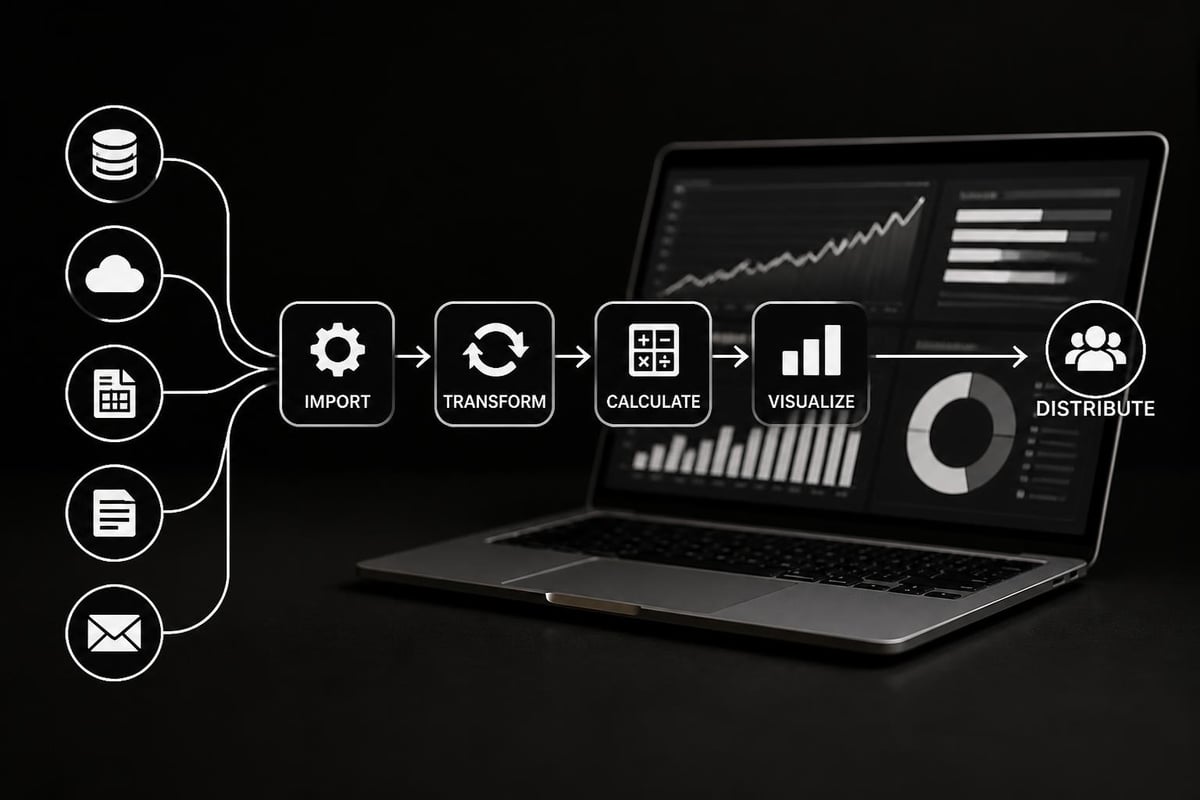
VBA macros automate multi-step processes that would otherwise consume hours of manual work. A consultant might create macros that import data from multiple CSV files, apply standardized formatting, update pivot tables, refresh charts, and email completed reports to stakeholders.
Recording macros provides a starting point for automation without requiring programming expertise. Excel captures every action you take and converts it into VBA code. While recorded macros often need refinement for efficiency, they offer tremendous value for users uncomfortable writing code from scratch.
Common marketing reporting tasks suited for macro automation:
- Importing and consolidating data from multiple exported files
- Applying consistent formatting and branding to reports
- Calculating derived metrics using standardized formulas
- Generating chart visualizations with fixed settings
- Distributing completed reports via email or shared drives
More experienced marketing analytics consultant excel specialists write custom VBA procedures that include error handling, user prompts, and conditional logic. These advanced macros adapt to varying data conditions and provide more robust automation.
Power Query for Sustainable Data Pipelines
While macros handle task automation, Power Query focuses specifically on data transformation. This distinction matters because Power Query maintains connections to source data, enabling one-click refreshes as new information becomes available.
A marketing consultant establishes Power Query connections to Google Analytics exports, advertising platform reports, and CRM databases. Each query defines the transformation steps needed to clean, reshape, and combine data. When next month's data arrives, clicking "Refresh All" updates the entire analytical workbook automatically.
Power Query's M language offers sophisticated transformation capabilities, including conditional columns, grouping operations, and pivot/unpivot functions. The visual interface generates this code automatically, making advanced transformations accessible without scripting knowledge.
Organizations seeking to transform spreadsheet data into visual insights often discover that Power Query eliminates the brittle, error-prone manual processes that plague traditional Excel workflows.
Client Communication and Insight Translation
Technical skill alone doesn't make someone an effective marketing analytics consultant excel professional. The ability to translate complex data patterns into clear strategic recommendations determines whether analytical insights drive actual business decisions.
Storytelling with Marketing Data
Numbers without context rarely inspire action. Effective consultants craft narratives around data that connect analytical findings to business objectives and market realities.
Consider presenting conversion rate improvements not as abstract percentages but as real revenue impacts and competitive advantages. "Our email optimization increased conversions from 2.3% to 3.1%" becomes "This email improvement generated an additional $47,000 in revenue last quarter and strengthened our position against competitors who typically see 2.5% rates."
Annotations on charts highlight important inflection points and explain what caused significant changes. A spike in website traffic deserves a callout noting the successful PR campaign that drove media coverage. A dip in engagement metrics needs explanation, whether due to algorithm changes, seasonal factors, or strategic shifts.
Executive Summaries and Action Items
Senior stakeholders lack time for detailed analytical deep-dives. Marketing analytics consultant excel reports should begin with executive summaries that answer three critical questions: What happened? Why did it happen? What should we do about it?
Bullet-point formats work well for executive summaries, presenting key findings and recommendations in scannable lists. Each point should be specific and measurable, avoiding vague observations like "social media performed well" in favor of precise statements like "LinkedIn generated 34% more qualified leads than target at 18% lower cost per lead."
Recommended actions must be concrete and prioritized. Rather than suggesting "optimize email campaigns," specify "Test subject line personalization in next week's newsletter targeting the enterprise segment, which showed 23% higher open rates in our April experiment."
Building Scalable Marketing Analytics Systems
As organizations grow, ad-hoc Excel analyses must evolve into systematic analytical frameworks. Marketing analytics consultant excel work increasingly focuses on building sustainable systems rather than one-off reports.
Template Development for Consistency
Standardized templates ensure consistent analysis across different campaigns, time periods, and team members. A consultant creates master templates that incorporate proven formulas, formatting standards, and validation rules.
These templates might include separate worksheets for raw data input, transformation calculations, summary metrics, and dashboard visualizations. Protected cells and data validation rules prevent accidental formula modifications while allowing appropriate data entry.
Version control becomes critical as templates evolve. Maintaining a template library with clear naming conventions (Marketing_Dashboard_v3.2_2026.xlsx) and change logs prevents confusion about which version teams should use.
Documentation and Knowledge Transfer
The most valuable consulting engagements don't create dependency but instead build client capabilities. Comprehensive documentation enables marketing teams to maintain and extend analytical systems after the consultant's engagement concludes.
Effective documentation includes formula explanations in plain language, workflow diagrams showing data flow through the workbook, and troubleshooting guides for common issues. Comments within cells explain complex formulas, while separate documentation files provide big-picture context.
Many marketing analytics consultant excel specialists offer specialized training services that help teams develop internal analytical capabilities. This knowledge transfer creates lasting value beyond immediate analytical deliverables.
Professional Development and Continuous Learning
The marketing analytics field evolves rapidly as new platforms emerge and methodologies advance. Maintaining relevance as a marketing analytics consultant excel expert requires ongoing skill development and industry awareness.
Essential Skills Beyond Excel Formulas
While Excel proficiency forms the foundation, successful consultants develop complementary capabilities that enhance their value proposition. Understanding marketing strategy, customer psychology, and industry benchmarks contextualizes analytical work within business realities.
Valuable adjacent skills for marketing analytics consultants:
- SQL for direct database querying and complex joins
- Python basics for advanced statistical modeling
- Data visualization best practices and design principles
- Marketing platform expertise (Google Analytics, HubSpot, Salesforce)
- Statistical analysis and experimental design fundamentals
Industry certifications demonstrate commitment to professional standards and provide structured learning paths. Google Analytics certification, Microsoft Excel Expert certification, and marketing analytics credentials from professional associations all enhance credibility with potential clients.
Staying Current with Excel Updates
Microsoft continuously enhances Excel's capabilities, introducing new functions and features that expand analytical possibilities. The introduction of dynamic arrays, XLOOKUP, and improved Power Query functionality over recent years has fundamentally changed optimal approaches to common tasks.
Following Excel-focused resources, including specialized training programs, keeps skills current and introduces new techniques. Testing new features in sandbox environments before deploying them in client work prevents unexpected issues.
Beta features in Excel for Microsoft 365 provide early access to upcoming capabilities. Forward-thinking consultants experiment with these features to stay ahead of the curve and provide cutting-edge solutions as features reach general availability.
Common Challenges and Troubleshooting Approaches
Even experienced marketing analytics consultant excel professionals encounter challenging scenarios that require creative problem-solving. Understanding common pitfalls and their solutions prevents wasted time and frustration.
Data Quality and Consistency Issues
Marketing data quality problems plague virtually every analytics initiative. Missing values, inconsistent naming conventions, duplicate records, and format variations require systematic approaches to identify and resolve.
Conditional formatting highlighting blanks, duplicates, and outliers provides visual scanning of data quality issues. The TRIM, PROPER, and CLEAN functions standardize text formatting, while IFERROR wraps formulas to handle missing data gracefully.
Data cleaning checklist for marketing datasets:
- Remove leading/trailing spaces in text fields
- Standardize date formats across all columns
- Verify numeric fields contain only numbers
- Check for duplicate transaction or customer records
- Validate category values against approved lists
- Confirm data ranges align with expected reporting periods
Building validation rules into templates prevents quality issues from entering analytical workbooks. Data validation restricts entries to approved values, custom number formats ensure consistent data entry, and conditional formatting flags suspicious values immediately.
Performance Optimization for Large Datasets
Marketing datasets frequently exceed Excel's comfortable performance limits. Workbooks with hundreds of thousands of rows and complex formula arrays can become frustratingly slow without optimization techniques.
Converting data ranges to Excel Tables improves formula calculation efficiency through structured references. Replacing volatile functions like INDIRECT and OFFSET with INDEX/MATCH or XLOOKUP reduces unnecessary recalculation. Breaking complex formulas into intermediate calculation steps rather than single massive formulas aids both performance and debugging.
When Excel's native capabilities prove insufficient, Power Pivot provides in-memory data modeling that handles millions of rows efficiently. DAX formulas in Power Pivot create measures and calculated columns without impacting worksheet performance.
Professionals managing complex workbooks understand the importance of proper spreadsheet architecture, which customized Excel development services can address through optimized template design and automation implementation.
Integration with Modern Marketing Technology
Excel doesn't exist in isolation within marketing technology ecosystems. Marketing analytics consultant excel specialists must understand how to connect Excel with the broader martech stack for comprehensive analytical capabilities.
API Connections and Data Extraction
Modern marketing platforms offer APIs that enable programmatic data extraction directly into Excel. Rather than manually downloading CSV files, consultants establish automated connections that pull fresh data on demand.
Power Query supports many API connections natively, while custom VBA scripts handle more complex authentication and data retrieval scenarios. Once configured, these connections transform Excel from a static reporting tool into a live dashboard reflecting real-time marketing performance.
Authentication requirements vary by platform, with some requiring OAuth tokens and others accepting simple API keys. Documentation of connection setup processes ensures continuity when team members change or systems require reconfiguration.
Hybrid Analytical Approaches
Sophisticated marketing analytics consultant excel strategies often combine Excel with complementary tools. SQL databases store historical data while Excel provides the analysis interface. Python scripts handle complex statistical modeling while Excel presents results in accessible visualizations.
This hybrid approach leverages each tool's strengths rather than forcing Excel to handle tasks better suited to other platforms. Excel's familiar interface and visualization capabilities make it ideal for stakeholder communication even when heavy computational work occurs elsewhere.
CSV file exchanges between systems provide simple integration points. Excel exports processed data that feeds into marketing automation platforms, while those platforms generate reports that Excel imports for further analysis and dashboard creation.
Mastering marketing analytics consultant excel capabilities transforms how organizations understand and optimize their marketing investments, turning scattered data into strategic intelligence that drives measurable business growth. Whether you're struggling with complex formulas, need automated reporting solutions, or want to build sophisticated marketing dashboards, The Analytics Doctor provides expert Excel help tailored to your specific analytical challenges, offering personalized training and practical solutions that make your marketing data work harder for your business.